


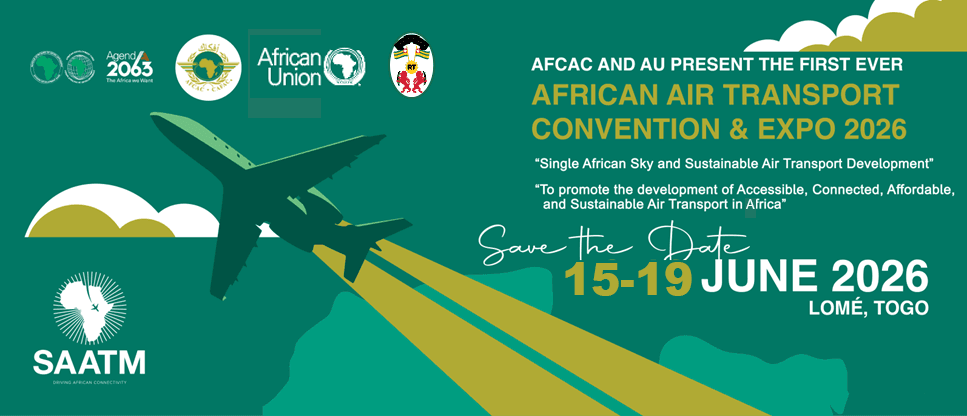
LOMÉ, Togo — Africa’s aviation leaders gather in Lomé today for the opening of the first-ever African Air Transport Convention & Expo, a five-day continental meeting aimed at accelerating the modernisation of the continent’s air transport sector and pushing forward the long-delayed promise of open African skies.
The convention, convened by the African Civil Aviation Commission and the African Union, runs from June 15 to 19 at Hôtel 2 Février in the Togolese capital. It brings together policymakers, regulators, airlines, airport operators, investors, maintenance, repair and overhaul providers, aviation training institutions, aerospace manufacturers, air navigation service providers, ground handlers, cargo operators, logistics firms, development partners and aviation innovators.
At the centre of the meeting is the Single African Air Transport Market, known as SAATM, the African Union flagship initiative aimed at liberalising air travel across the continent by opening market access, improving route connectivity, and reducing barriers that continue to make African air travel expensive, fragmented, and inefficient.
The Lomé gathering is expected to seek high-level commitments from governments and industry players to accelerate SAATM implementation, reduce the cost of air transport, improve competitiveness and advance smoother movement of passengers and cargo through better visa and facilitation measures.
Organisers are also placing strong emphasis on air cargo corridors linked to the African Continental Free Trade Area. The convention is expected to prioritise bankable cargo and trade corridors, with joint work plans and corridor “owner” arrangements intended to move discussions beyond declarations and into implementation.
The Expo will also focus on mobilising investment for airports, air navigation service providers and cargo logistics infrastructure. Across the continent, weak infrastructure, limited route networks, high taxes, restrictive bilateral air service agreements and uneven regulatory capacity have continued to constrain aviation growth.
Another major focus will be regulatory readiness, safety, security and sustainability. Delegates are expected to discuss sustainable aviation fuel, lower-carbon aviation fuel, climate resilience, aviation technology, digital transformation and human capital development.
Expected outcomes include a Lomé Ministerial Declaration on accelerated SAATM implementation, a continental policy framework on taxes, fees, and charges, updated air service agreements or side letters to operationalise fifth-freedom opportunities, and the endorsement of priority cargo and trade corridors with joint work plans.
The convention is also expected to produce a bankable project pipeline for airport and air navigation service modernisation, framework actions on sustainable and lower-carbon aviation fuels, finance commitments, memoranda of understanding and the launch and onboarding plan for an African Route Development Platform.
Lomé carries symbolic weight in Africa’s aviation liberalisation story. On July 12, 2000, the city hosted the formal adoption of the Yamoussoukro Decision by the Assembly of Heads of State and Government of the Organisation of African Unity. That decision remains the legal and policy foundation for the liberalisation of African air transport markets.
Nearly 26 years later, the continent is on track to turn that commitment into a functioning aviation market. For many African passengers and businesses, travel between African countries remains costly, slow and often indirect. Cargo movement faces similar bottlenecks, weakening the promise of regional trade under AfCFTA.
The Lomé convention therefore opens not merely as another aviation conference, but as a test of whether African governments, regulators and industry players can convert policy ambition into practical connectivity.
For entrepreneurs, exporters, tourism operators, logistics firms and ordinary travellers, the stakes are even more dire. A more connected African air transport market could mean cheaper routes, faster movement of goods, stronger regional supply chains and greater access to markets across the continent.
