


LOMÉ, Togo — African aviation ministers and heads of delegation have adopted the Lomé Ministerial Declaration, committing governments to accelerate the Single African Air Transport Market, reduce the cost of flying, open routes, strengthen air cargo corridors and turn decades of aviation liberalisation promises into measurable outcomes.
The declaration, adopted in Lomé on June 16 during the African Air Transport Convention and Expo 2026, now stands as the political centrepiece of the five-day continental gathering convened by the African Civil Aviation Commission and the African Union.
The Expo brought together governments, regulators, airlines, airports, investors, development finance institutions, cargo operators, aviation training institutions, air navigation service providers, technology firms and development partners.
One of the central questions, which has gone unanswered for decades and is now even more pressing, remains: Can Africa finally open its skies to work for the development of its people?
The answer from Lomé was a renewed commitment to act.
The declaration calls for the full and effective implementation of the Yamoussoukro Decision and the Single African Air Transport Market as a priority agenda for African integration and development. It commits African states to remove market access barriers, align bilateral air service agreements with SAATM principles, facilitate the use of traffic rights and create transparent processes for airline designation, authorisation and route commencement.
It also recognises that SAATM requires collaboration and cooperation across various sectors. It cannot be delivered by aviation authorities alone. Ministers committed to stronger coordination between transport, civil aviation, finance, trade, tourism, immigration, customs, infrastructure, security and investment authorities.
That whole-of-government language is one of the most significant parts of the declaration. It acknowledges a common sentiment that echoed across the Lomé Expo throughout the week: Africa’s air transport problem can not be reduced to an airline problem. It is, fundamentally, a multi-faceted tax, visa, border, financing, regulatory and political coordination problem.
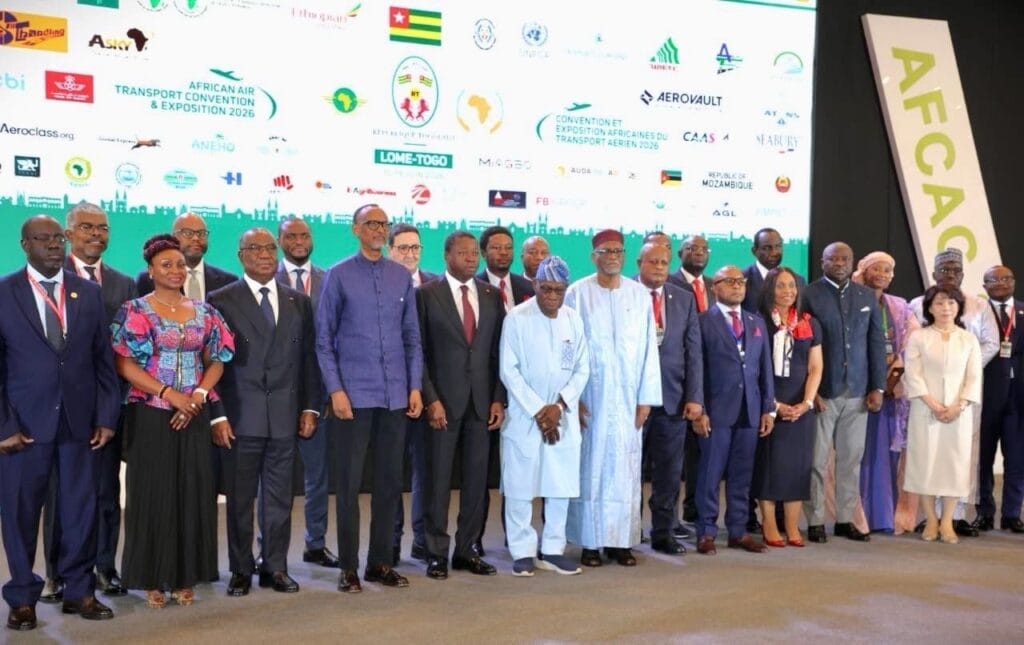
The declaration comes after several high-level interventions at the Expo, including speeches by Rwandan President Paul Kagame and former Nigerian President Olusegun Obasanjo, who both warned that Africa already has the tools it needs but continues to fall short on implementation.
Kagame told delegates that Africa has spoken for decades about integration, trade and free movement.
“We know what has to be done. We just have to do it,” he said.
He also warned that in many cases, the fastest route between two African cities is still through another continent, a reality he said weakens trade, discourages investment and prevents businesses from operating at scale.
Obasanjo also created a sombre moment of reflection. The former Nigerian president said Africa does not need another beautiful declaration that gathers dust on a shelf. What the continent needs, he said, are decisions that cut costs, open routes, connect capitals, move cargo, boost tourism, support airlines, protect consumers and allow Africa to function as one economic area.
The Lomé Declaration appears designed to respond to that challenge.
One of its strongest commitments is on the cost of African air travel. Ministers acknowledged that excessive and poorly coordinated taxes, fees and charges raise the cost of air travel and air freight, reduce demand, weaken route viability and limit aviation’s contribution to trade, tourism and economic growth.
To address this, the declaration endorses a Continental Harmonised Policy Framework on Aviation Taxes, Charges and Fees. The framework is intended to guide African governments towards transparent, consultative, cost-effective, non-discriminatory and growth-focused aviation charges.
Ministers also committed to national and regional reviews of aviation taxes, fees and charges, with the aim of identifying high or duplicated costs and implementing practical measures to make flying more affordable while maintaining essential aviation services.
The declaration also places air cargo at the centre of Africa’s trade ambitions. Ministers committed to supporting priority intra-African passenger and cargo corridors aligned with SAATM, AfCFTA value chains, regional economic priorities, tourism, e-commerce, agriculture, pharmaceuticals, light manufacturing and logistics.
AFCAC, working with the AfCFTA Secretariat, regional economic communities, member states, airlines, airports, cargo operators and partners, has been asked to prioritise corridor route packages. These are expected to include market access measures, facilitation reforms, cargo infrastructure, commercial partnerships and investment needs.
This gives the declaration a wider economic meaning. It links aviation directly to the African Continental Free Trade Area, where the movement of goods, services and people remains central to the continent’s ability to build regional value chains and increase intra-African trade.
The declaration also calls for practical mobility reforms. Ministers recognised that restrictive visa regimes, inconsistent border procedures, weak facilitation systems, and inefficient cargo clearance continue to limit mobility, route viability, tourism, trade, and the passenger experience.
They committed to advancing greater visa openness, visa-on-arrival and e-visa arrangements, risk-based border management, ICAO Annex 9 standards and recommended practices, passenger data systems, improved cargo clearance and digital travel processes.
That language closely reflects Kagame’s earlier reference to Rwanda’s own visa reforms.
President Kagame said Rwanda removed visa barriers because it wanted people to visit, connect and discover opportunities. He said the country saw stronger business activity, increased tourism and expanded air links, arguing that openness and cooperation are powerful drivers of development.
Infrastructure financing is another major pillar of the Lomé outcome.
The declaration commits ministers to supporting the preparation, packaging and financing of viable aviation infrastructure projects, including airports, air navigation systems, cargo facilities, digital systems, safety and security infrastructure and corridor-related investments.
It also urges development finance institutions, private investors and partners to back a continent-wide aviation infrastructure pipeline using blended finance, public-private partnerships, de-risking instruments and project preparation support.
One of the recurring arguments at the Expo was that Africa’s aviation sector needs investable projects, credible institutions, safer systems, better airports, modern air traffic management and bankable cargo infrastructure.
According to AFCAC, 38 African countries have joined SAATM, representing more than 80 per cent of the continent’s existing aviation market. An IATA survey suggests that if just 12 key African countries opened their markets, an additional 155,000 jobs and $1.3 billion in annual GDP could be created.
Those figures give the Lomé Declaration an economic urgency.
It is now beyond question that aviation can support African growth; the onus has been placed on governments to remove the barriers that prevent aviation from doing so.
The declaration also moves into sustainability and technology. Ministers committed to supporting Africa’s involvement in the development, production, financing and deployment of Sustainable Aviation Fuels, Lower Carbon Aviation Fuels and other cleaner aviation energy solutions.
They also committed to promoting digital transformation, aviation data systems, air traffic management modernisation, airport and cargo technologies, safety oversight tools, training, maintenance, unmanned aircraft systems and other emerging technologies.
Human capital is included as a core part of the outcome. The declaration calls for attention to the next generation of aviation professionals, with an emphasis on skills development, technology transfer, institutional partnerships and increased participation of women and youth.
The safety and regulatory commitments are also significant. Ministers reaffirmed that aviation liberalisation must be supported by strong safety and security oversight, fair competition, consumer protection and harmonised economic regulation.
They committed to strengthening implementation of international standards and recommended practices, improving regulatory cooperation, supporting institutional capacity-building and improving resilience against emerging safety, security, public health, climate and operational risks.
A major institutional outcome is the launch of the AFCAC Solidarity Commitment 2026–2028. The declaration describes it as a voluntary, transparent and results-driven mechanism to mobilise financial contributions, technical assistance, secondments, tools, systems, training and project-based support for approved continental aviation priorities.
The solidarity mechanism, as stated in the declaration, does not create new statutory assessments or binding financial obligations for member states. Instead, it provides a practical platform for states, partners, financial institutions, industry and private sector actors to support implementation.
AFCAC has also been asked to establish transparent governance, accountability and reporting arrangements for the mechanism and to provide an annual report on resources mobilised, activities supported and results achieved.
The declaration further welcomes the African Union Theme of the Year 2027 as a strategic opportunity to elevate SAATM implementation to the highest political level. It asks the African Union Commission, AFCAC, the AfCFTA Secretariat, AUDA-NEPAD, UNECA and regional economic communities to work with member states to develop a practical SAATM Implementation Roadmap for 2027–2028.
That roadmap is expected to identify key actions, responsible institutions, timelines, resource needs and monitoring arrangements.
AFCAC is also requested to implement a Post-Lomé Implementation Matrix covering SAATM implementation, aviation taxes and charges reduction, facilitation reforms, corridor route development, infrastructure investment, sustainability, innovation, resource mobilisation and reporting.
This follow-up mechanism may determine whether the declaration becomes a real turning point or another policy document in a long history of African aviation promises.
The Lomé Declaration also positions Africa for the Seventh ICAO Worldwide Air Transport Conference, scheduled for Montreal in November 2026. Ministers endorsed Africa’s consolidated priorities for that conference, including development-aligned liberalisation, affordability, SAATM implementation, bankable infrastructure financing, regulatory strengthening, digital air traffic management, workforce development, sustainability and removal of barriers such as visa restrictions, weak industry leadership and excessive taxes and charges.
The declaration closes by thanking President Faure Essozimna Gnassingbé, the President of the Council of the Republic of Togo and SAATM Champion President, as well as the Government and people of Togo, for hosting the Expo. It also acknowledges President Paul Kagame of Rwanda for his leadership in promoting African aviation and continental integration.
AFCAC Secretary General Adefunke Adeyemi had described the Expo before its opening as more than a gathering.
“This event is more than a gathering,” she said. “It is a defining moment for African aviation. It is where ambition meets action.”
The declaration now tests that claim.
