

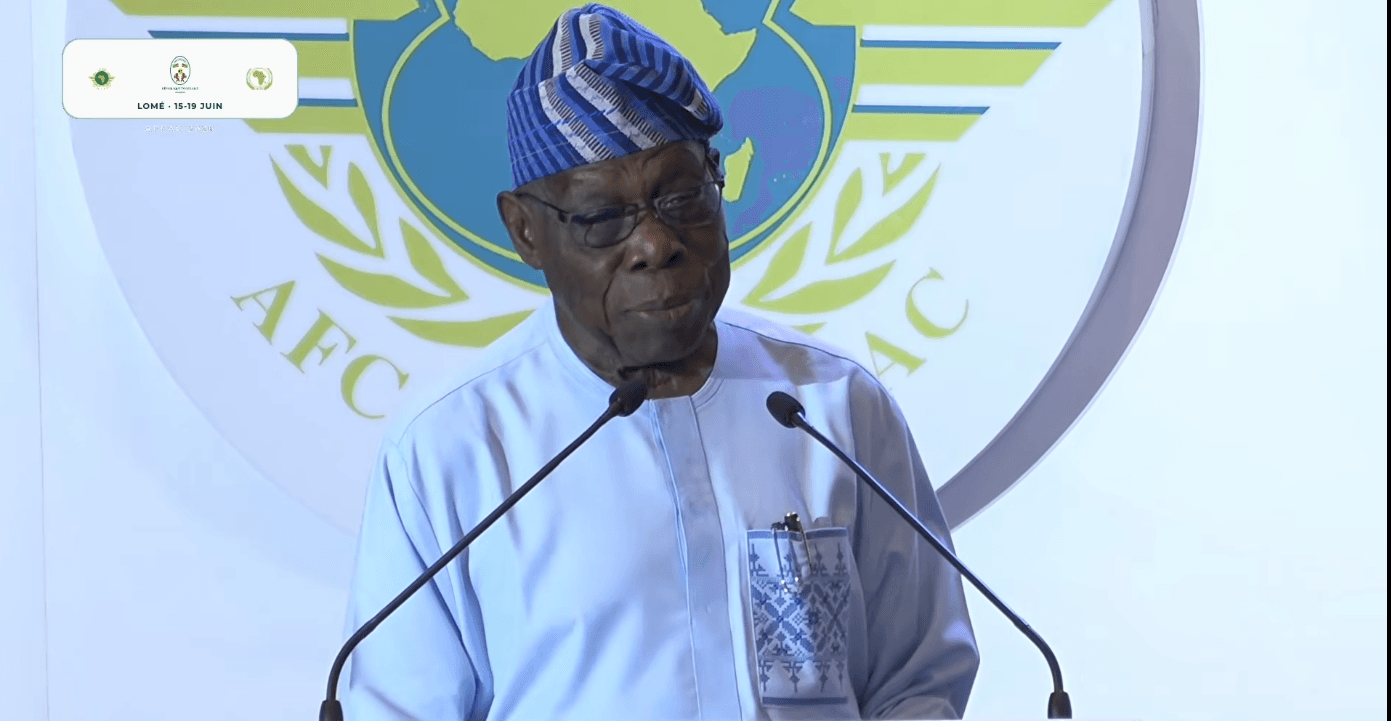
LOMÉ, Togo — Former Nigerian President Olusegun Obasanjo has urged African governments to move beyond declarations and take practical decisions that cut the cost of air travel, open routes, move cargo faster and make aviation a working engine of continental integration.
Speaking today at the opening of the first African Air Transport Convention and Expo in Lomé, Obasanjo said Africa already has the institutions, policy frameworks and development tools needed to transform its aviation sector. What remains, he argued, is disciplined implementation.
“Africa does not need another beautiful declaration that gathers dust on a shelf,” Obasanjo said. “Africa needs decisions that cut costs, open routes, connect capitals, move cargo, boost tourism, support airlines, protect consumers, and ensure our continent functions as one economic area.”
The five-day convention, convened by the African Civil Aviation Commission and the African Union, brings together governments, regulators, airlines, airport operators, investors, development finance institutions, cargo operators, logistics firms and aviation innovators.
At the centre of the meeting is the Single African Air Transport Market, or SAATM, the African Union initiative designed to liberalise air transport across the continent and improve connectivity between African countries.
Obasanjo said SAATM must stop being treated as a ceremonial commitment and become operational through bilateral air service agreements, route approvals, competition rules, consumer protection systems and the treatment of African airlines.
“If Africans cannot travel easily within Africa, then AfCFTA will remain limited,” he said. “If our airlines cannot connect our markets, then our businesses will stay fragmented.”
His remarks placed aviation at the heart of Africa’s wider economic integration agenda. Obasanjo said the African Continental Free Trade Area cannot be driven by speeches alone, but by infrastructure, logistics, standards, payment systems, border efficiency and transport.
He also warned that high taxes, charges and fees are making African air travel unaffordable and weakening the continent’s growth prospects.
“Taxes, charges, and fees that make air tickets unaffordable are not revenue strategies; they are barriers to growth,” he said. “A passenger who cannot afford to fly generates no tax, no trade, no tourism, and no opportunity.”
Obasanjo further called for every African trade corridor to include an air connectivity plan, every tourism strategy to include an air access plan, and every regional value chain to ask how people, goods and services can move more quickly, cheaply and reliably.
He said aviation infrastructure also needs serious financing, including investment in airports, air navigation systems, cargo terminals, maintenance facilities, digital border systems and climate-resilient infrastructure.
Development finance institutions and technical partners, he said, should work with African governments to prepare bankable projects rather than endless wish lists.
The former Nigerian leader also linked air transport reform to mobility, arguing that visa restrictions, slow border procedures and weak facilitation systems continue to undermine the same integration African leaders say they support.
He called for wider adoption of digital identity systems, passenger information systems, risk-based security and facilitation standards that make it easier for Africans to move across the continent.
“Our borders should become bridges, not barriers,” Obasanjo said. “The free movement of people is not a luxury; it is the human face of integration.”
He also challenged African airlines to improve governance, reliability and cooperation, saying governments can open the skies, but airlines must use those skies responsibly.
The Lomé convention comes at a symbolic moment for African aviation. In July 2000, Lomé hosted the formal adoption of the Yamoussoukro Decision, the policy foundation for liberalising African air transport markets.
Nearly 26 years later, many African travellers still face high ticket prices, limited direct routes, visa barriers and long detours when moving between African countries. Cargo movement remains constrained by weak logistics systems, limited capacity and fragmented markets.
Obasanjo said the issue before Africa is no longer whether the continent has the right tools.
“We have SAATM. We have AfCFTA. We have AU Agenda 2063. We have RECs. We have AFCAC. We have AUDA-NEPAD. We have financial institutions. We have technical partners. We have entrepreneurs. We have young people ready to move, trade and create,” he said.
“The key issue is whether we possess the discipline to carry out the implementation.”
For Obasanjo, the test of the Lomé convention will not be the quality of speeches delivered or declarations signed, but whether it produces decisions that are felt by passengers, airlines, exporters, tourism operators and entrepreneurs.
He said Africa must build a continent where a young entrepreneur in Lagos can reach Lomé, Nairobi, Kigali, Accra, Cairo or Johannesburg without unnecessary difficulty.
“Let this Convention be remembered not only as the first of its kind,” he said, “but as the moment when Africa transitioned from ambition to action.”
