

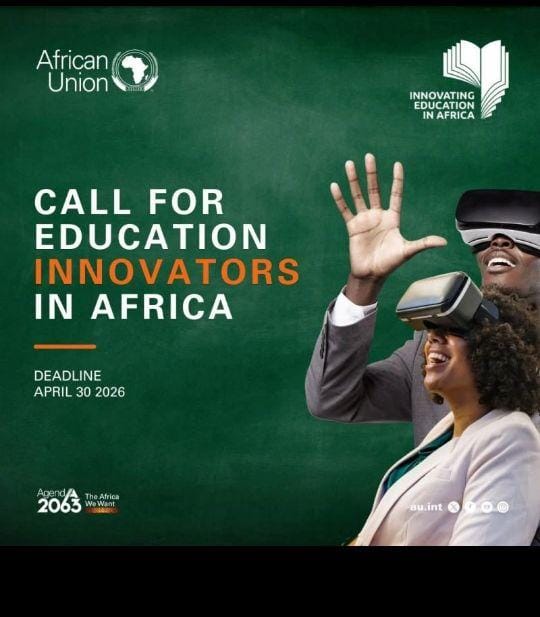
With just 10 days left before the closing date of the African Union Commission’s Education Innovators Call, the urgency is growing for young Africans to step forward with ideas and solutions to help reshape education systems across the continent.
The call comes at a time when many African education systems remain under pressure, especially in communities where access to quality learning is still shaped by geography, infrastructure, and inequality. For young people working at the intersection of education, technology, and innovation, this is more than just an application window. It is an opportunity to respond to some of the continent’s deepest and most persistent challenges.
To reflect on why this call matters, we spoke to engineer, entrepreneur, and physicist Luthando Maqondo, a STEM innovator from Southern Africa whose own journey mirrors many of the barriers young Africans continue to face.
Across many parts of Africa, education systems still struggle with deep structural challenges. In many schools, especially in rural communities, learners contend with inadequate infrastructure, long distances to school, water scarcity, limited access to laptops and science laboratories, frequent electricity blackouts, and weak or non-existent internet connectivity.
For many learners, access to education is not simply a right. It often feels like a daily struggle against systemic barriers.
In this context, digital transformation and educational innovation are no longer optional; they are essential.
A personal journey shaped by science and innovation.
Reflecting on his own story, Maqondo said these challenges are lived realities.
He holds a BSc in Nuclear Science and Engineering and an Honours degree in Physics from the University of the Witwatersrand. During his Master’s studies in Photonics and Optical Physics, he co-authored published research in areas including free-space optical communications, spatial-mode light engineering, and quantum-inspired techniques.
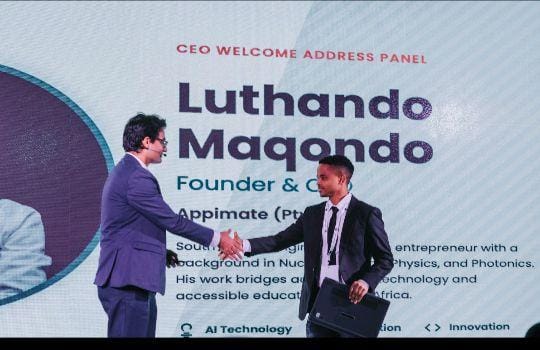
Today, he is the co-founder and CEO of Appimate, where he leads the development of AI-driven software products for enterprise and consumer markets, with a focus on scalable digital systems, cloud infrastructure, and applied artificial intelligence.
But his journey into science and technology began in far more constrained conditions.
Growing up in a rural part of South Africa’s Eastern Cape, access to learning materials was often delayed. In many cases, textbooks arrived late, slowing learning progress and widening inequality between rural and urban schools. Access to technology was even more limited.
“I only started properly interacting with a laptop when I reached university,” he said. “Before that, education was entirely offline, and opportunities to explore digital tools were almost nonexistent.”
That lived experience continues to shape his mission: using technology to help bridge the very gaps he once faced.
Shaping Africa’s emerging AI ecosystem
Beyond his company, Maqondo is also playing an active role in Africa’s emerging artificial intelligence ecosystem. He is involved in the MCP Hackathon Africa, a continent-wide initiative led by Cortex Hub that brings together developers, startups, and researchers across more than 40 cities.
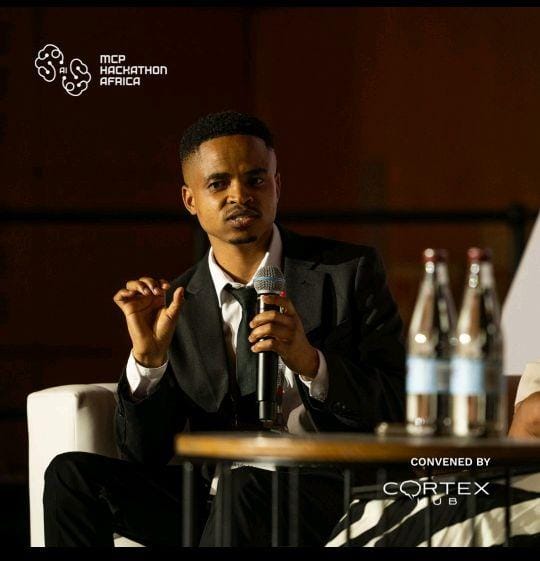
The programme focuses on building real-world AI solutions using the Model Context Protocol, an open standard for context-aware and interoperable AI systems. In this role, Maqondo leads technical engagements and delivers intensive bootcamps on MCP, equipping participants across Africa with the skills to contribute to next-generation AI infrastructure.
His interdisciplinary work spans open-source innovation, generative AI, and computer vision, anchored by a guiding vision: “Computer vision to world understanding.”
Why is Luthando encouraging Southern African youth to step forward?
Maqondo said he is encouraging youth and education innovators from the Southern African region to step forward because of the unique challenges and contradictions shaping the region’s education landscape.
While Southern Africa is often recognised for having some of the most progressive education policies on the continent, he said there remains a growing gap between policy design and implementation. According to him, this disconnect is most visible in communities where learners continue to face structural barriers, from unequal access to infrastructure and digital tools to under-resourced schools that struggle to translate policy into lived educational outcomes.

For Maqondo, this is why youth-led innovation is no longer optional, but necessary.
He said young people must play a central role in bridging the gap between policy and practice by designing solutions that are practical, scalable, and grounded in real classroom realities.
He also linked this urgency to the broader global conversation on youth and education, arguing that young people should not be treated only as beneficiaries of education systems, but as active co-creators of their future.
For Southern Africa, he said, this is a direct call to action: to move beyond policy ambition and ensure that implementation, innovation, and impact are driven by those who understand the system from the inside.
Why does the AU Education Innovators Call matter?
For innovators like Maqondo, the African Union’s Education Innovators Call represents more than just an opportunity. It is a platform to reimagine education systems from the ground up and contribute directly to Agenda 2063, the African Union’s long-term vision for “The Africa We Want.”
It gives young people space to design context-driven solutions for African classrooms, address infrastructure and digital access gaps, rethink rural education delivery models, and integrate technology meaningfully into learning environments.
More importantly, it signals a shift by recognising youth not simply as recipients of education systems, but as co-creators of reform.
With the deadline fast approaching, the call places a timely challenge before Africa’s young innovators: not just to imagine a better education system, but to help build it.
