


Zimbabwean Paradox
Strive Masiyiwa’s life can be read as a story of extraordinary entrepreneurial achievement, but it can also be read as an indictment.
Born in what was then Rhodesia and educated partly in Britain, Masiyiwa returned to newly independent Zimbabwe as a young engineer and eventually set out to build a mobile telephone company at home, only to discover that his greatest early obstacle was neither technology nor demand, but the state.
He fought the Zimbabwean government for five years for permission to compete in telecommunications, and Econet Wireless Zimbabwe finally began operating in 1998 after a protracted legal battle. Nearly three decades later, Econet is only one part of a business empire spanning telecommunications, fiber-optic infrastructure, financial technology and other investments. Masiyiwa now lives in London, and Forbes estimates his fortune at roughly $2.2 billion. He is also recognized as Britain’s first Black billionaire.
Another Zimbabwean, Valerie Moran, moved to London in 2004, entered the technology industry and helped build Prepaid Financial Services, a financial technology company she co-founded with her husband. In 2019, Moran became the first Black woman to appear on The Sunday Times Rich List, and is widely considered as the wealthiest Black woman in the United Kingdom.
Then there is James Manyika, whose path ran from the University of Zimbabwe, where he studied electrical engineering and first encountered research related to neural networks, to Oxford as a Rhodes Scholar and, eventually, Silicon Valley. Today, Mr. Manyika is Google’s Senior Vice President for Research, Labs, Technology & Society, helping oversee some of the world’s most consequential work in artificial intelligence, computing and science.
In Johannesburg, Ralph Mupita, another Zimbabwe-born engineer, has led MTN Group, one of Africa’s largest telecommunications companies, since 2020, after a career spanning engineering, financial services and senior leadership at Old Mutual.
It is tempting to assemble these biographies into an uplifting account of Zimbabwean excellence, but a darker and more revealing question lies behind them: How does a country whose name became synonymous with economic failure continue to produce people capable of succeeding at the highest levels of the global economy? And what does it say about Zimbabwe that so many of them have had to leave?
A Different Kind of Export
Zimbabwe is rich in things the world wants, gold, platinum, tobacco and lithium, but another of its exports appears less often in trade statistics — Zimbabweans themselves. They work as doctors, engineers, academics, accountants, executives and technology professionals across the world’s wealthiest economies.
Measuring the diaspora precisely is difficult because national censuses, Zimbabwean government figures and migration databases produce substantially different estimates, in part because migrants move again, acquire new citizenships or are counted differently across jurisdictions. Individual destination countries, however, offer a clearer view.
The 2021 Australian census counted 39,714 residents born in Zimbabwe, Britain also has a substantial Zimbabwe-born population estimated to exceed 122,000 and South Africa has for decades been the largest destination for Zimbabwean migration. A 2025 International Organization for Migration survey of Zimbabweans abroad was itself dominated by respondents in South Africa and Britain, underscoring the importance of those two migration corridors even though the survey was not designed as a census of the diaspora.
A health labour-market analysis published through the World Health Organization’s African Health Observatory reported that the English National Health Service employed 4,049 Zimbabwean doctors, nurses and clinical support workers in 2019, at the time the second-largest African contingent after Nigeria’s.
The comparison is startling because Zimbabwe had only about 21,372 doctors and nurses serving its public health sector in 2020, and the report estimated that roughly one in five doctors and nurses trained in Zimbabwe was working in the English N.H.S. Zimbabwe still needed them, in 2022, it had only about half the density of doctors, nurses and midwives required to meet the international benchmark used in the global health-workforce strategy for 2030.
This is the brain drain crippling many African nations. A government and families finance the formation of a nurse, a university trains a doctor, and a society bears the cost of producing that professional through childhood, schooling and clinical education, only for another economy to receive much of the productive return.
Britain gets the nurse, Australia the engineer, South Africa the executive and Silicon Valley the computer scientist, while Zimbabwe gets, among other things, a remittance. Those remittances are hardly trivial, with the World Bank estimating that personal remittances were equivalent to about 8.5 percent of Zimbabwe’s Gross Domestic Product in 2024.
But money sent home is not the same as having the person there, a remittance can pay a school fee but cannot teach a class, build a house but cannot perform surgery, and support consumption but cannot, by itself, replace the institutions, companies and professional communities that migrate with people.
Zimbabwe’s paradox is therefore partly a question of accounting – How should a country value human capital that it created but no longer fully possesses?
An Early Investment in Schools
To understand why Zimbabwe produces so many internationally portable professionals, one must return to the first years after independence. When majority rule arrived in 1980, the new government inherited an education system profoundly shaped by racial inequality and responded with one of the most ambitious expansions of mass education in postcolonial Africa.
Zimbabwe had 177 secondary schools in 1979 and 1,512 by 1990. Over the same period, secondary-school enrollment rose from 74,321 pupils in 1980 to 672,656 a decade later, while primary enrollment increased from about 1.24 million to more than 2.1 million. Education became more than public policy; it became a social contract.
Across urban and rural Zimbabwe, generations of parents came to regard schooling as the most dependable inheritance they could provide, while professional qualifications became markers not merely of employment, but of mobility and status.
What followed is central to the paradox, because Zimbabwe’s political and economic institutions deteriorated much faster than its accumulated culture of education disappeared. A school system can be damaged without immediately erasing the aspirations of families that have believed in it for generations, just as a university can lose lecturers and equipment while still enrolling demanding students, and an economy can destroy professional opportunity faster than a society stops producing professionals. That divergence created one of Zimbabwe’s strangest accomplishments – it continued to prepare people for jobs that increasingly existed elsewhere.
The World Bank has described Zimbabwe as possessing “excellent human capital,” including a youthful and well-educated labour force, even as it identified serious structural weaknesses in the economy surrounding that labour force. It also found that the skills of Zimbabwe’s workers were, in some respects, comparable with those in upper-middle-income economies in sub-Saharan Africa. The people were not the only problem; the machinery around them was breaking.

When the Economy Stopped Keeping Up
Few countries have offered as spectacular a demonstration of what monetary disorder can do to ordinary life. Zimbabwe’s long economic deterioration had multiple causes and remains politically contested, with land reform and the disruption of commercial agriculture, sanctions and international isolation, corruption and governance failures, fiscal deficits, monetary expansion, declining investment, political uncertainty and repeated policy mistakes all forming part of the history. By 2008, however, the result was unmistakable.
The International Monetary Fund estimated that annual inflation reached nearly 500 billion percent at its peak that year, after which the Zimbabwe dollar effectively disappeared from normal circulation and the country adopted a basket of foreign currencies for everyday commerce. Businesses failed, savings evaporated, investment declined and formal employment contracted, even as professionals discovered that a qualification could retain its value after the salary attached to it had ceased to do so. Hyperinflation did not make a Zimbabwean engineer less capable of engineering; it made a Zimbabwean salary less capable of retaining an engineer.
The World Bank’s account of the two decades after 2000 describes an economy marked by extremely low average growth, high volatility, collapsing investment, increasing labour migration and an expanding informal sector, which by 2020 was estimated at more than 60 percent of GDP. Zimbabwe’s crisis can therefore be understood also as the widening gap between the economic value of a Zimbabwean inside Zimbabwe and the value the same person could command elsewhere. That gap became powerful enough to move families across continents.
The Same Person, a Different Economy
Consider a highly trained Zimbabwean nurse working in a poorly equipped provincial hospital, where equipment is scarce, salaries lose value, promotion is uncertain and staffing shortages make the hours relentless. Place the same nurse in a well-funded British hospital with reliable electricity, functioning equipment, specialist colleagues, dependable procurement, stable wages, a pension and a trusted currency, and neither her underlying intelligence nor her training has changed. The economic system surrounding her has.
Productivity is never solely an individual characteristic, because institutions multiply, or suppress, what individuals can accomplish. Mr. Manyika illustrates the same principle at the other end of the skills spectrum. Zimbabwe helped educate him through a Bachelor’s Degree in Electrical Engineering at the University of Zimbabwe, and he later earned advanced degrees at Oxford in fields encompassing artificial intelligence, robotics, mathematics and computer science.
The essential counterfactual is not whether Zimbabwe could produce a James Manyika, because it did, but whether it could build an institution capable of retaining and fully deploying one. Could a Zimbabwean research laboratory provide the computing infrastructure required for frontier artificial-intelligence research?
Could a local technology company offer a comparable platform for experimentation, could universities compete for researchers against institutions with multibillion-dollar endowments, or could domestic capital markets finance companies at the scale required to keep their most ambitious founders? This is where discussions of African brain drain can mislead by treating migration as the event requiring explanation, when the more consequential event may have come first, that is, the failure to build institutions capable of using the brain.
The Selection Problem
Successful Zimbabweans abroad are not a random sample of Zimbabweans. Crossing a border to build a life abroad often requires qualifications, savings, information, professional accreditation, family networks, tolerance for risk or some combination of them.
The visibility of successful Zimbabweans abroad therefore does not prove that Zimbabweans as a population possess some exceptional national characteristic. Britain’s census data illustrates the broader pattern, showing that foreign-born residents of England and Wales are disproportionately represented among people with higher qualifications, in part because study and skilled work are important routes into the country. The Zimbabwean diaspora may appear unusually accomplished partly because migration has filtered the population, sending abroad many of the people with the credentials and drive that destination countries reward.
When a struggling economy disproportionately loses the people best equipped to build companies, universities, hospitals and public institutions, the consequences compound. The migration of one doctor creates a vacancy, but the migration of hundreds changes a health system; the departure of one lecturer disrupts a classroom, but the departure of generations of academics reshapes an academic system.
The departure of one entrepreneur is personal mobility, but the departure of enough entrepreneurs changes where companies are founded, taxes are paid, intellectual property is registered and jobs are created. As institutions weaken, the incentive to leave grows, and as capable people leave, the institutions become harder to rebuild.
Masiyiwa’s Other Story
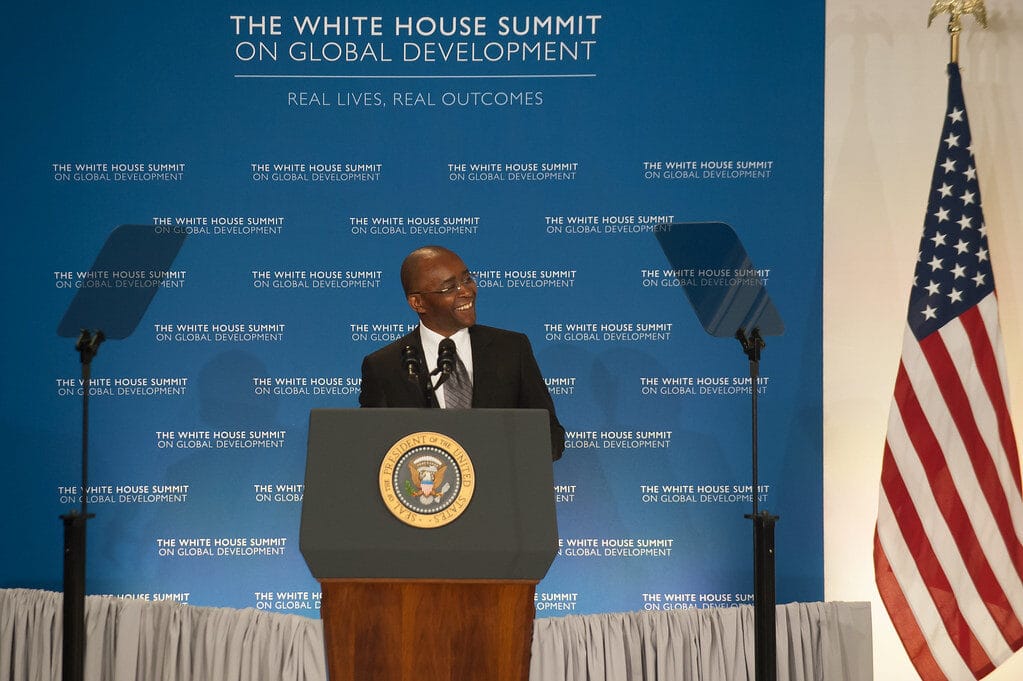
This is what makes Mr. Masiyiwa’s career particularly useful for understanding Zimbabwe. His story is often told as a parable of perseverance, in which an entrepreneur confronts government obstruction, fights through the courts and ultimately triumphs. Development economics poses a different question: How many entrepreneurs should have to be that persistent?
Mr. Masiyiwa survived the institutional obstacle and became a billionaire, but the unseen cases are those who did not. They are the entrepreneurs whose licenses never came, the researchers whose laboratories were never financed, the doctors who emigrated, the companies that remained small because capital was inaccessible, the investors who judged the currency risk too high and the formal businesses that retreated into an informal economy because informality appeared safer than regulation. In its analysis of Zimbabwe, the World Bank identified regulatory burdens, weak governance, macroeconomic instability and policy distortions as important contributors to informality and weak productivity.
The celebrated entrepreneur who succeeds despite such conditions may provide a comforting national mythology, but countries do not become prosperous by requiring every entrepreneur to become a hero. They become prosperous by making ordinary competence productive.
The Zimbabwean Company That Never Existed
Perhaps the most consequential loss cannot be found by counting emigrants at all, because it is the company that was never built. Instead of asking only how many doctors or engineers left Zimbabwe, consider how many organizations left with them in embryonic form.
What might a Zimbabwean financial-services company founded by a Valerie Moran have become, what research institute might have formed around a scientist like James Manyika, and what telecommunications companies might have emerged if the regulatory environment that confronted Mr. Masiyiwa had encouraged a generation of competitors instead? What consulting firms, biotechnology companies, engineering practices and specialist hospitals were never created because their potential founders built careers elsewhere?
This is the invisible side of brain drain. Countries lose not merely labour, but institutions before those institutions are born. The wealthier destination country, meanwhile, gains a taxpayer, consumer, employer, mentor, patent holder, investor and, perhaps, the founder of the next company.
A Recovery Complicates the Picture
Zimbabwe today is not the Zimbabwe of 2008, and its recent economic indicators have improved.
The World Bank estimates that growth accelerated from 1.7 percent in 2024 to 7.5 percent in 2025, supported by a rebound in agriculture and higher mining prices. Local-currency inflation fell sharply to 4.1 percent from a year earlier in January 2026.
The government has also begun another effort to normalize relations with international financial institutions. In 2026, the International Monetary Fund approved a staff-monitored program intended to strengthen macroeconomic management and establish a policy record that could eventually support debt restructuring and international re-engagement. By July the fund said that implementation through the first review had been broadly satisfactory. But the legacy is enormous, with Zimbabwe’s public and external debt still unsustainable and the country classified as being in debt distress.
More fundamentally, stabilizing a currency is not the same as rebuilding an ecosystem. A professor considering a return asks about research financing, a surgeon about equipment, an entrepreneur about capital, an investor about property rights and policy predictability, and an engineer about whether industry exists at sufficient scale. A parent asks about schools, while a professional family asks whether the improvement will survive the next political or monetary shock.
Economic credibility accumulates slowly because memory does not disappear when inflation falls.
From Brain Drain to Brain Circulation
There is also a danger in treating the diaspora solely as a national loss, because Zimbabweans abroad have never entirely left Zimbabwe. They finance households, educate relatives, build houses, establish companies, support charities and send knowledge, contacts and capital home. Mr. Masiyiwa’s businesses and philanthropy remain deeply connected to Africa and Zimbabwe, meaning that his wealth cannot be reduced to British wealth acquired through the disappearance of a Zimbabwean entrepreneur. Migration is more complicated than extraction, and a Zimbabwean professional in London can belong economically to both places.
A software engineer in Toronto can invest in Harare, a professor in Calgary can supervise African scholars, a doctor in Birmingham can periodically train colleagues at home, and a business executive in Johannesburg can connect Zimbabwean companies to regional capital. The relevant policy goal may therefore no longer be to reverse migration, but to make geography less decisive. India, China and Taiwan have demonstrated in different ways that diasporas can become conduits for investment, technology and knowledge when domestic conditions become sufficiently attractive.
Zimbabwe’s challenge is to turn an emigrant population into a network, which requires looking beyond the remittances governments often celebrate because they provide foreign currency. The Zimbabwean working at Google may possess something more transformative than the money he sends home, knowledge, just as the executive running a multinational possesses networks, the surgeon abroad specialist techniques, the entrepreneur experience in forming capital and the academic access to research institutions. The diaspora’s greatest asset is its proximity to functional systems.
The Question Behind the Paradox
There is a story Zimbabweans sometimes tell themselves about their country. Despite everything that happened to it, its people survived. The diaspora appears to prove the point, with Zimbabweans establishing businesses in foreign capitals, entering elite universities, becoming doctors, engineers and executives, and sending money to parents and children while starting again thousands of miles from home. It is an admirable story, but survival is a low ambition for a country that once invested so heavily in producing capable people.
The more difficult question is what all those people might have accomplished if institutions at home had multiplied their abilities instead of institutions abroad rescuing them. Zimbabwe’s post-independence achievement was to widen access to education dramatically, while its subsequent failure was to build an economy that expanded opportunity at anything like the same pace. I
That is why the Zimbabwean paradox is both triumphant and tragic. Every globally successful Zimbabwean demonstrates something the country got right, while every one who had to leave to succeed may reveal something it did not. The country’s economic crisis was never merely the story of a currency that stopped working; it was the story of the distance that opened between human capability and national possibility.
